


Released On 26th May 2026
Ferrari’s First Electric Supercar Is Here
TL;DR: Ferrari once said it would never build an electric car – now its first EV, the Luce, arrives with over 1,000hp and design by Sir Jony Ive. It’s a clear sign that electric and high‑tech cars are here to stay, and that drivers need garages who can genuinely handle modern vehicle technology.
Ferrari’s First Electric Supercar Is Here – What It Means For Everyday Drivers
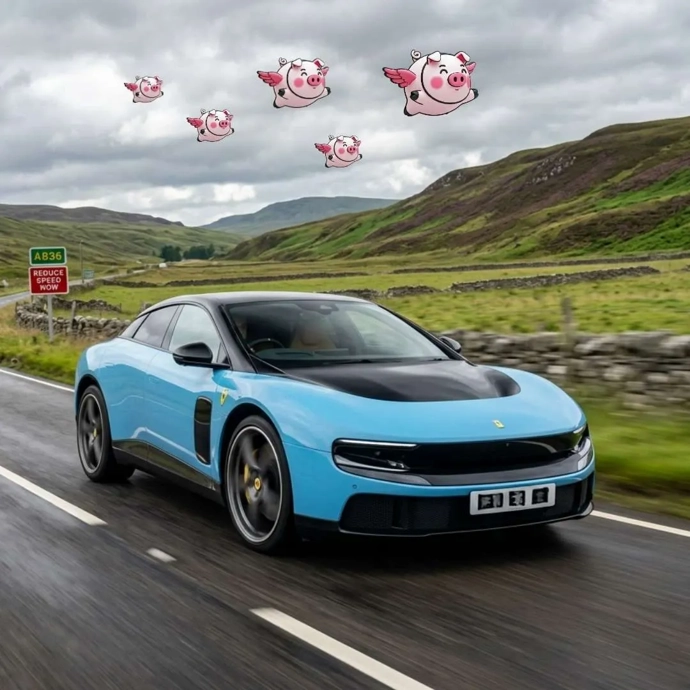
When Ferrari unveils an all‑electric car, the rest of the motoring world takes notice. The new Ferrari Luce – a 1,000hp+ fully electric, four‑door, 5-seats GT – isn’t just a halo product, it’s a clear sign that electric and high‑tech vehicles are now firmly part of the mainstream.
At Okee, we see this shift in our workshop every week. More of the cars coming through our doors are hybrids and EVs packed with sensors, software and safety systems. As the technology moves on, the way these cars are maintained and repaired has to move on too.
Ferrari Luce: the poster car for a new era
Ferrari built its reputation on high‑revving engines, manual gearboxes and an unmistakable soundtrack, so choosing to launch a fully electric model is a major moment. The Luce is Ferrari’s first production EV and its first five‑seat model, designed around four electric motors and a large high‑voltage battery that doubles as part of the chassis.
On paper, the numbers are eye‑opening. The Luce delivers over 1,000 horsepower, accelerates from 0–100 km/h in around 2.5 seconds and has a top speed north of 310 km/h, all while offering a range of more than 500 km between charges. Underneath, it uses an 800‑volt electrical architecture, advanced cooling systems, torque‑vectoring at each wheel and active suspension to keep that performance usable and safe.
To keep the driving experience feeling “Ferrari”, engineers have even developed an authentic sound profile that uses real vibrations from the electric drivetrain rather than fake engine noise. It’s a good example of how modern vehicles now blend mechanical engineering, electronics, acoustics and software into a single system.
From “never electric” to the Luce
Only a little over a decade ago, Ferrari’s then‑chairman Luca di Montezemolo was adamant the company would never build an electric car, saying “you will never see a Ferrari electric because I don't believe in electric cars.” At the time, EVs were seen as a niche experiment by some, and many in the performance world questioned whether batteries and motors could ever deliver the emotion and character expected from a brand like Ferrari.
Fast‑forward to 2026 and Ferrari’s first fully electric model, the Luce, is not a reluctant box‑ticking exercise – it is the new flagship, with over 1,000hp, four doors and a ground‑up electric platform. That shift says as much about the wider market as it does about Ferrari; electric and electrified vehicles have matured to the point where even the most traditional performance brands see them as the future, not a compromise.
The fact that Ferrari has chosen to work with Sir Jony Ive and Marc Newson’s LoveFrom studio on the Luce’s design underlines that commitment. This is a carefully considered product, with its user experience, interior and physical controls designed to feel timeless rather than like a gadget that will date quickly, which mirrors where the EV market as a whole is heading – towards long‑term, mainstream adoption rather than early‑adopter novelty.
For drivers of more ordinary cars, Ferrari’s new position is a powerful signal of the direction of travel and the strength of the electric car market. If a brand that once publicly dismissed electric cars now leads with a halo EV, it’s a strong testament to how far the technology has come – and how important it is to have garages that genuinely understand high‑voltage systems, advanced electronics and modern diagnostics.
What this has to do with your car
You might not be ordering a €550,000 Ferrari, but the technology in the Luce filters down incredibly quickly. Features like high‑voltage batteries, powerful electric motors, complex stability systems, four‑wheel steering, ADAS cameras and radar are already common on everyday family cars, SUVs and company vehicles.
For drivers, this brings real benefits... more performance, better efficiency and improved safety, but it also changes what “servicing” actually means. Looking after a modern vehicle now involves:
-
Managing high‑voltage safety on hybrid and electric models
-
Reading and interpreting multiple control modules, not just a single engine ECU
-
Calibrating ADAS systems (lane‑keeping, adaptive cruise, emergency braking, parking sensors, cameras and radar) after repairs or alignment work
-
Understanding how suspension geometry, tyre wear and driver‑assist systems all link together
That’s why many general garages are starting to struggle with complex faults, intermittent warning lights or issues that sit somewhere between “mechanical” and “electrical”. The tools, training and time required are simply very different from the days of simple engines and basic ABS.
How Okee fits into this high‑tech future
The arrival of a car like the Ferrari Luce underlines a shift that’s already at the heart of Okee’s direction: modern vehicle faults need modern expertise. We’ve repositioned Okee as a modern vehicle technology specialist – not just a general garage – to give local drivers the kind of technical support these newer cars demand.
At Okee, our core focus areas now include:
- Electric and hybrid vehicle care – servicing, safety checks, fault‑finding and high‑voltage awareness
- Advanced diagnostics – structured investigation of warning lights, drivability issues and communication faults between modules
- Electrical fault‑finding – tracking down wiring, battery drain and sensor problems methodically, rather than guessing at parts
- ADAS and driver‑assistance systems – assessing and supporting calibration for cameras, radar, parking sensors and related systems
- 3D alignment and suspension geometry – using precision equipment to protect tyres, optimise handling and support ADAS performance
We peovide technical expertise. That means we don’t promise “a quick look”... instead, we book vehicles into detailed diagnostic and assessment slots so our technicians have proper time to test, interpret and explain what’s really going on.
When to talk to a specialist like Okee
You don’t need to own a Ferrari for modern vehicle technology to affect you; in fact, the cars that cause the most confusion are usually ordinary hybrids, EVs or newer petrol and diesel vehicles used every day. It’s worth speaking to a specialist if:
- You have persistent or intermittent warning lights
- Your hybrid or EV is due a service and you’re unsure if a normal garage can work on it safely
- ADAS systems like lane‑keep assist, emergency braking or parking sensors have stopped working or shown messages after a repair
- You’re seeing uneven tyre wear, pulling or poor handling even after a basic “tracking” adjustment
- You’ve already tried another garage, but the fault is still there or keeps coming back
In each of these situations, the first step is a structured diagnostic assessment, not guesswork. Our job is to investigate the fault properly, explain your options in plain English and help you make a clear, confident decision about the next step.