


Released On Today
Turtle Mode Warning Light... What It Means and What to Do
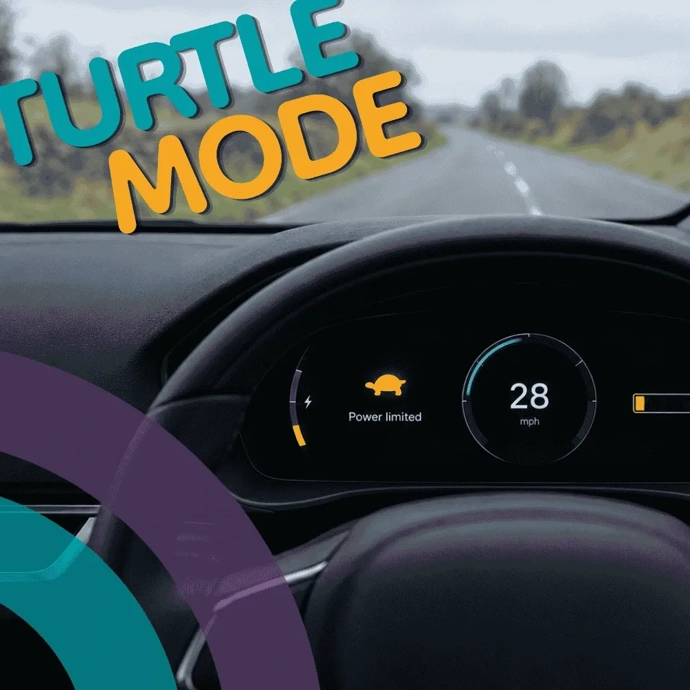
You're driving along, everything feels normal, and then a little turtle pops up on the dashboard. The car suddenly feels sluggish. Press the accelerator and not much happens.
It's one of the friendlier looking warning lights out there, but you have no choice but to take it seriously. Here's what Turtle Mode is, why your car switches it on, and when it's time to get the vehicle to your local EV/Hybrid expert.
What is turtle mode?
Turtle mode is a reduced power mode used by electric and hybrid vehicles. When the car's systems decide something isn't right, they deliberately limit motor power and top speed, and a turtle (or tortoise) symbol appears on the dash. It's the electric version of "limp mode"… the car protects itself and gives you enough power to get somewhere safe, but not much more.
Different manufacturers handle it in slightly different ways. Skoda, for example, labels the symbol "Limited or insufficient driving performance". An amber turtle can mean the battery is very cold or the charge is getting low, while a red one means the battery has hit a minimum energy level or is extremely cold.
Why does it happen?
The most common reason is simple… the battery is nearly flat. But it isn't the only one. Turtle mode can come on for a few different reasons:
- Very low charge. The car is stretching what's left in the battery so you can reach a charger.
- Battery temperature. A pack that's too hot or too cold can't safely deliver full power. Hot weather combined with repeated rapid charging and long fast runs is a known trigger on some older EVs.
- A weak cell or module. As batteries age, some cells weaken faster than others. When you put the car under load, like a hard pull away or a steep hill, the weakest cell's voltage can dip, and the battery management system cuts power to protect it.
- A 12-volt or electrical fault. EVs still rely on a small 12-volt battery to run their control systems. If that voltage drops, for example because the DC-DC converter that keeps it topped up has failed, the car can go into turtle mode and may shut down the drivetrain soon after.
- Other powertrain faults. Problems with the motor, inverter or charging system can also cause the car to limit power.
The one that should make you suspicious
If the turtle appears when the battery is low, that's the car doing its job. Charge up and carry on.
If it appears when the gauge shows plenty of charge, and it isn't freezing outside, that points to a genuine fault. The early Nissan Leaf is a well-known example. Owners have reported turtle mode with 20 to 30 per cent, or more, still showing on the gauge. That's usually down to cell imbalance, ageing modules, or the car's estimate of remaining charge drifting away from what the battery can actually deliver.
In other words, the gauge isn't always telling the whole story. Diagnostics will.
What to do if the turtle light comes on
Don't panic. You'll still have some power, just not much. Here's what we'd suggest:
- Get somewhere safe. Turtle mode can cap your speed quite hard, sometimes around 30 to 40mph. On the motorway or a fast A-road, signal early and leave at the next safe exit, or pull over where it's safe to.
- Drive gently. Hard acceleration, hills and high speeds put the most strain on the battery. Smooth, steady driving makes the most of what's left.
- Cut the extras. Turning the heating or air con down reduces the load.
- Check your charge. If the battery is low, head for the nearest charger and charge up properly.
- Note what else is on the dash. An EV system warning, "power limited" message or red battery light alongside the turtle is useful information for whoever diagnoses the car.
If the battery was low and the turtle goes away after a full charge, you're probably fine. If it keeps coming back, appears with a good amount of charge, or shows up alongside other warnings, it's time to have it looked at.
Proper diagnostics matter
Turtle mode is a symptom, not a diagnosis. The same light can be caused by a tired 12-volt battery, a failing converter, a temperature issue or a weak high-voltage cell, and those are very different jobs at very different costs.
Guessing is how people end up paying for parts they didn't need. Reading the fault codes and looking at what the battery management system is actually reporting, including individual cell voltages and battery health, shows what's really going on before anything gets replaced.
How Okee can help
At Okee, we work on electric and hybrid vehicles as well as everything else that comes through the door. That includes fault diagnosis, warning lights, charging concerns, battery-related issues and electrical faults. We have the training and equipment to work on modern vehicle technology safely, and we'll always explain what we've found, in plain English, before any work goes ahead.
If your car has been showing the turtle, or just doesn't feel like it's pulling the way it used to, give us a call on 01823 617790 or book online. We're at Chelston Business Park in Wellington, open Monday to Friday, 8am to 5:30pm.