



Released On 28th Jul 2026
Uneven Tyre Wear: What It Says About Your Alignment, Suspension & Safety
Uneven tyre wear TL;DR: if your tyres are wearing more on one edge, in patches or with a feathered/cupped texture, it’s usually a sign of misaligned geometry, worn suspension or incorrect tyre pressures – and it’s a safety issue, not just a cost one. Don’t just fit new tyres and hope for the best; book a proper suspension check and 3D four‑wheel alignment so the car’s steering, braking and driver‑assist systems can work as they should, and your next set of tyres lasts far longer.
Uneven tyre wear is still your car’s way of warning you about deeper issues with alignment, suspension and safety... and it’s worth acting on quickly, not just at MOT time.
Why uneven tyre wear matters
Uneven tread shortens tyre life, but more importantly it changes how your car grips, brakes and steers, especially in wet or emergency situations. When the contact patch is patchy or biased to one edge, your ABS and stability systems have less consistent grip to work with, so they may not be able to help you avoid an accident as effectively. In the UK, badly worn or uneven tyres are a common MOT failure and can lead to fines or points, but the bigger risk is losing control when you need the car most. Treat any odd wear pattern as a safety warning, not just a cosmetic or comfort issue.
What your tyres are trying to tell you
Different wear patterns act like clues about what’s happening underneath the car:
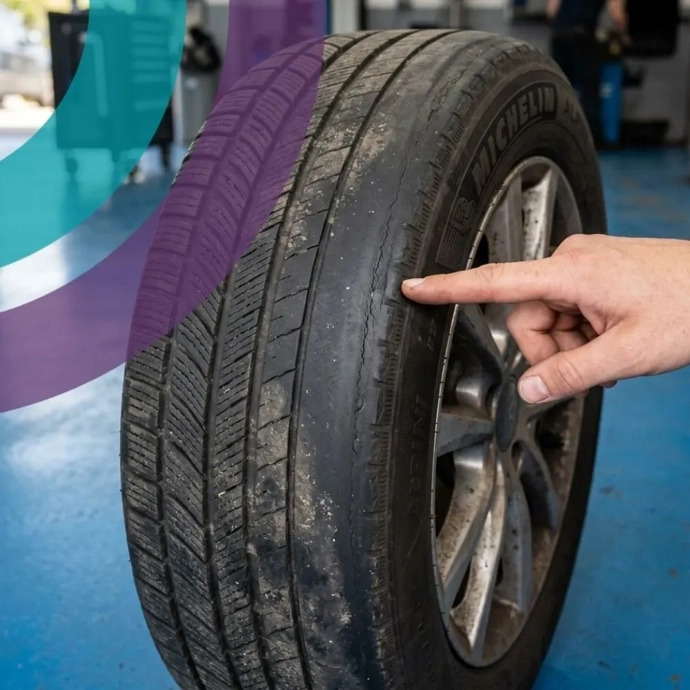
Inner or outer edge wear often points to incorrect camber or toe settings, or to worn suspension bushes that let the wheel lean or steer more than it should.
Both shoulders worn with a higher‑looking centre usually means underinflation, where a soft tyre runs on its edges and overheats the sidewalls.
Centre wear suggests overinflation; too much pressure lifts the shoulders and concentrates load in the middle of the tread.
Feathering – tread blocks feeling smooth in one direction and sharp in the other – typically indicates incorrect toe or free play in steering joints.
Cupping or scalloping, with wavy high/low spots around the tread, is often linked to tired shocks, bent suspension components or imbalance.
Even a quick sweep of your hand around the tyre can reveal feathering or cupping that’s hard to see at a glance, especially on wide, low‑profile tyres. If you notice any of these patterns, it’s a sign to stop thinking “bad tyre” and start thinking “what’s happening with the suspension and alignment?”
Alignment: beyond basic “tracking”
On many modern cars, especially those with ABS, traction control and ADAS driver‑assist systems, alignment is about full 3D four‑wheel geometry, not just a quick front‑wheel tracking tweak. Misaligned geometry typically shows up as edge wear, feathering across the tread, a steering wheel that sits off‑centre or the car pulling left or right even on a straight road. Toe, camber and caster angles are set to tight tolerances; when they drift, the tyre scrubs across the road surface rather than rolling cleanly, generating heat and removing rubber far faster than normal. On newer vehicles, these angles also influence how your driver‑assist systems “see” the road, so poor alignment can affect lane‑keeping and emergency braking performance as well as tyre life.
That’s why specialists strongly recommend a 3D 4‑wheel alignment check if you see uneven tyre wear, feel pulling or notice that the steering wheel isn’t straight, rather than just swapping tyres front‑to‑back and hoping the problem goes away.
Suspension and bushes: the hidden culprits
If alignment is the set‑up, suspension hardware is the physical reality that has to hold that set‑up in place every time you hit a bump, brake or turn.
Some of the most common issues include:
- Worn suspension bushes, the rubber mounts that link arms to the chassis; when they crack, soften or split, the wheel can move more than it should, knocking alignment angles out and rapidly wearing edges or creating patchy tread.
- Tired shocks and struts that no longer control bounce properly, leading to cupping patterns and a car that feels unsettled or noisy over rough roads.
- Loose ball joints and steering links, which introduce free play so the wheels never quite track straight, showing up as vague steering, knocks and uneven wear.
These aren’t just comfort problems; worn or loose suspension components are serious enough to cause MOT failures because they affect how the car responds to steering and braking inputs. As a rule, any steering or suspension repair should be followed by a proper alignment check so the geometry matches the new hardware.
Tyre care, safety and what to do next
Not all uneven wear is purely mechanical – tyre pressure, rotation and driving style still matter – but they sit on top of your car’s underlying health and don’t replace it.
A few simple habits make a big difference:
- Check tyre pressures at least once a month and before long trips, using the figures on the door pillar or in the handbook, to avoid edge‑wear from underinflation and centre‑wear from overinflation.
- Inspect tread across the full width of each tyre, not just one spot, looking for bald sections, edge wear or any pattern that differs side‑to‑side.
- Rotate tyres on the schedule recommended by your vehicle manufacturer, especially on front‑wheel‑drive cars where front tyres work harder and can wear very differently from the rear.
- If you’re fitting new tyres because the old ones were uneven, combine the job with a 3D alignment and suspension check... it’s the best way to protect that new investment and avoid scrubbing the next set in half the mileage.
Most importantly, don’t ignore what your tyres are trying to tell you. If you notice uneven wear, feel the car pulling, or hear knocks from the suspension, book a suspension check and full alignment rather than waiting for the MOT to catch the problem or for a wet‑weather emergency to expose it.